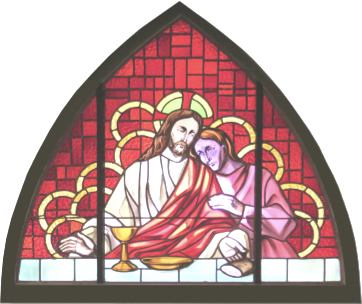
- 5 April 2026 – Palm Sunday – Holy Mass, for the rite is long, possibly we will try to start from 6;00 am – 9;00 am. We ask your patience if it goes after the said time.
- 6-8 April 2026 – Holy week – 6:15 – 8:0 pm Adoration (Kyrie eleison) every day in the church.
- 9 April 2026 – Holy Thursday – 6:15 – 8:00 pm – Holy Mass and washing of feet.
- 10 April 2026 – Good Friday – 9:00 am – 4:00 pm – Friday Adoration.
- 11 April 2026 – Holy Saturday – 6:00 – 8:00 – Holy Mass and distribution of Sedge.
- 11 Aprile 2026 – Easter Vigil of the Lord’s Resurrection – 9:00 pm – 2:00 am (night) Holy Easter Mass.
Author: Fr. Jim
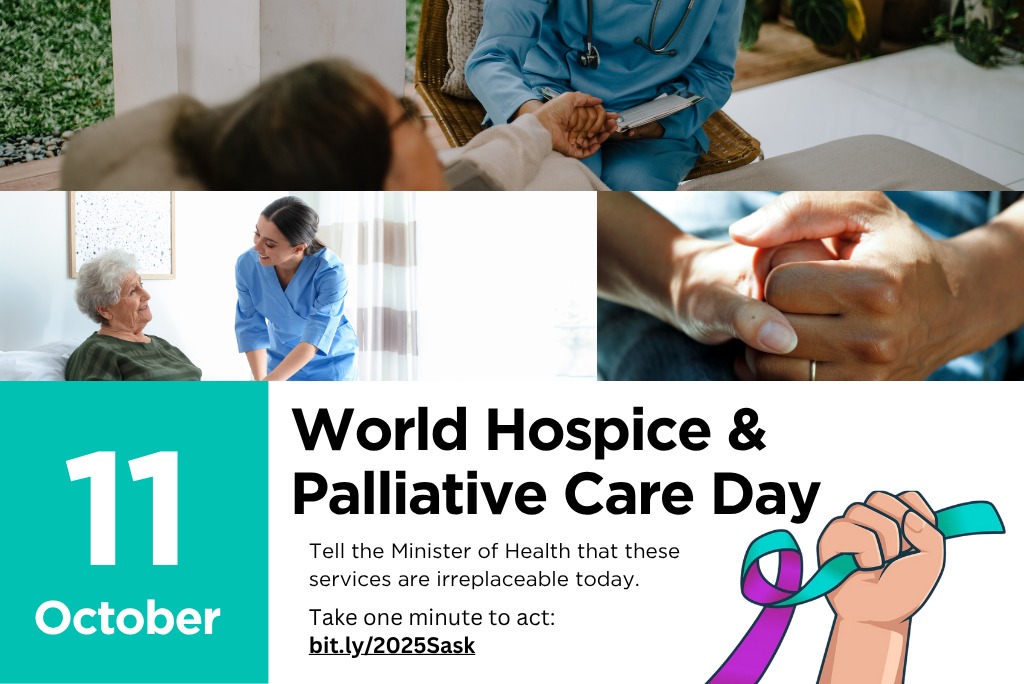
World Hospice and Palliative Care Day • October 11th
Hello friends,
This Saturday marks World Hospice and Palliative Care Day, a global call to ensure that every person can receive comfort, care, and dignity at the end of life.
Here in Saskatchewan, we’ve seen hopeful progress with new hospices in Saskatoon and Prince Albert. Yet the need for quality palliative care continues to grow far faster than the resources available.
-
In Saskatoon alone, the palliative home care team now follows more than 600 patients, more than double from just a few years ago, with no increase in staffing to match.
-
When families cannot access support at home or in care facilities, loved ones can feel abandoned or forced into choices they never wanted like MAiD.
-
In 2023, only 61% of Saskatchewan residents who received MAiD were known to have had palliative care.
As Canada expands Medical Assistance in Dying (MAiD) in 2027 to include mental illness, this growing gap in care puts our most vulnerable at risk.
Now is the time to act.
Together, we can urge our provincial leaders to strengthen palliative care, invest in home supports, and ensure that every person receives care that honours life at every stage.
Take one minute to make a difference:
Your voice matters. Stand for compassionate care in Saskatchewan.
With hope and gratitude,
The Archdiocese of Regina
MESSAGE OF POPE LEO XIV FOR THE 111th WORLD DAY OF MIGRANTS AND REFUGEES 2025
Migrants, missionaries of hope
Dear Brothers and Sisters!
The 111th World Day of Migrants and Refugees, 4-5 October 2025 which my predecessor chose to coincide with the Jubilees of Migrants and of the Missions, offers us an opportunity to reflect on the connections between hope, migration and mission.
The current global context is sadly marked by wars, violence, injustice and extreme weather events, which force millions of people to leave their homelands in search of refuge elsewhere. The widespread tendency to look after the interests of limited communities poses a serious threat to the sharing of responsibility, multilateral cooperation, the pursuit of the common good and global solidarity for the benefit of our entire human family. The prospect of a renewed arms race and the development of new armaments, including nuclear weapons, the lack of consideration for the harmful effects of the ongoing climate crisis, and the impact of profound economic inequalities make the challenges of the present and the future increasingly demanding.
Faced with frightening scenarios and the possibility of global devastation, it is important that there be a growing desire in people’s hearts for a future of peace and of respect for the dignity of all. Such a future is essential to God’s plan for humanity and the rest of creation. This is the messianic future anticipated by the prophets: “Old men and old women shall again sit in the streets of Jerusalem, each with staff in hand because of their great age. And the streets of the city shall be full of boys and girls playing in its streets… For there shall be a sowing of peace; the vine shall yield its fruit, the ground shall give its produce, and the skies shall give their dew” (Zech 8:4-5, 12). This future has already begun, since it was inaugurated by Jesus Christ (cf. Mk 1:15; Lk 17:21), and we believe and hope in its full realization, for the Lord is always faithful to his promises.
The Catechism of the Catholic Church teaches: “The virtue of hope responds to the aspiration to happiness which God has placed in the heart of every man and woman; it takes up the hopes that inspire human activities” (N. 1818). What is more, the search for happiness, and the prospect of finding it beyond one’s place of origin, is certainly one of the main motivations for the movement of people today.
This link between migration and hope is clearly evident in many contemporary experiences of migration. Many migrants, refugees and displaced persons are privileged witnesses of hope. Indeed, they demonstrate this daily through their resilience and trust in God, as they face adversity while seeking a future in which they glimpse that integral human development and happiness are possible. Moreover, we can see the itinerant experience of the people of Israel repeated in their own lives: “O God, when you went out before your people, when you marched through the wilderness, the earth quaked, the heavens poured down rain at the presence of God, the God of Sinai, at the presence of God, the God of Israel. Rain in abundance, O God, you showered abroad; you restored your heritage when it languished; your flock found a dwelling in it; in your goodness, O God, you provided for the needy” (Ps 68:7-10).
In a world darkened by war and injustice, even when all seems lost, migrants and refugees stand as messengers of hope. Their courage and tenacity bear heroic testimony to a faith that sees beyond what our eyes can see and gives them the strength to defy death on the various contemporary migration routes. Here too we can find a clear analogy with the experience of the people of Israel wandering in the desert, who faced every danger while trusting in the Lord’s protection: “he will deliver you from the snare of the fowler and from the deadly pestilence; he will cover you with his pinions, and under his wings you will find refuge; his faithfulness is a shield and buckler. You will not fear the terror of the night, or the arrow that flies by day, or the pestilence that stalks in darkness, or the destruction that wastes at noonday” (Ps 91:3-6).
Migrants and refugees remind the Church of her pilgrim dimension, perpetually journeying towards her final homeland, sustained by a hope that is a theological virtue. Each time the Church gives in to the temptation of “sedentarization” and ceases to be a civitas peregrine, God’s people journeying towards the heavenly homeland (cf. Augustine, De Civitate Dei, Books XIV-XVI), she ceases to be “in the world” and becomes “of the world” (cf. Jn 15:19). This temptation was already present in the early Christian communities, so much so that the Apostle Paul had to remind the Church of Philippi that “our citizenship is in heaven, and it is from there that we are expecting a Savior, the Lord Jesus Christ. He will transform the body of our humiliation that it may be conformed to the body of his glory, by the power that also enables him to make all things subject to himself” (Phil 3:20-21).
In a special way, Catholic migrants and refugees can become missionaries of hope in the countries that welcome them, forging new paths of faith where the message of Jesus Christ has not yet arrived or initiating interreligious dialogue based on everyday life and the search for common values. With their spiritual enthusiasm and vitality, they can help revitalize ecclesial communities that have become rigid and weighed down, where spiritual desertification is advancing at an alarming rate. Their presence, then, should be recognized and appreciated as a true divine blessing, an opportunity to open oneself to the grace of God, who gives new energy and hope to his Church: “Do not neglect to show hospitality to strangers, for by doing that some have entertained angels without knowing it” (Heb 13:2).
The first element of evangelization, as Saint Paul VI emphasized, is that of witness: “All Christians are called to this witness, and in this way they can be real evangelizers. We are thinking especially of the responsibility incumbent on migrants in the country that receives them” (Evangelii Nuntiandi, 21). This is a true missio migrantium, a mission carried out by migrants, for which adequate preparation and ongoing support must be ensured through effective inter-ecclesial cooperation.
At the same time, the communities that welcome them can also be a living witness to hope, one that is understood as the promise of a present and a future where the dignity of all as children of God is recognized. In this way, migrants and refugees are recognized as brothers and sisters, part of a family in which they can express their talents and participate fully in community life.
On this Jubilee, when the Church prays for all migrants and refugees, I wish to entrust all those who are on the journey, as well as those who are working to accompany them, to the maternal protection of the Virgin Mary, comfort of migrants, so that she may keep hope alive in their hearts and sustain them in their commitment to building a world that increasingly resembles the Kingdom of God, the true homeland that awaits us at the end of our journey.
LEO PP. XIV
Message of Pope Leo XIV for World Day of Migrants and Refugees 2025
MESSAGE of HIS HOLINESS POPE LEO XIV for the 10th WORLD DAY of PRAYER for the CARE OF CREATION 2025
Dear Brothers and Sisters!
The theme of this World Day of Prayer for the Care of Creation, chosen by our beloved Pope Francis, is “Seeds of Peace and Hope”. On the tenth anniversary of the establishment of this Day of Prayer, which coincided with the publication of the Encyclical Laudato Si’ , we find ourselves celebrating the present Jubilee as “Pilgrims of Hope.” This year’s theme thus appears most timely.
In proclaiming the Kingdom of God, Jesus often used the image of the seed. As the time of his Passion drew near, he applied that image to himself, comparing himself to the grain of wheat that must die in order to bear fruit (cf. Jn 12:24). Seeds are buried in the earth, and there, to our wonder, life springs up, even in the most unexpected places, pointing to the promise of new beginnings. We can think, for example, of flowers springing up on our roadsides from seeds that landed up there almost by chance. As those flowers grow, they brighten the gray tarmac and even manage to break through its hard surface.
In Christ, we too are seeds, and indeed, “seeds of peace and hope.” The prophet Isaiah tells us that the Spirit of God can make an arid and parched desert into a garden, a place of rest and serenity. In his words, “a spirit from on high will be poured out on us, and the wilderness will become a fruitful field, and the fruitful field a forest. Then justice will dwell in the wilderness, and righteousness abide in the fruitful field. The work of righteousness will be peace, and the work of righteousness, quietness and trust forever. My people will abide in a peaceful habitation, in secure dwellings, and in quiet resting places” (Is 32:15-18).
These words of the prophet will accompany the “Season of Creation,” an ecumenical initiative to be celebrated from 1 September to 4 October 2025. They remind us that, together with prayer, determination and concrete actions are necessary if this “caress of God” is to become visible to our world (cf. Laudato Si’ , 84). The prophet contrasts justice and law with the desolation of the desert. His message is extraordinarily timely, given the evidence in various parts of the world that our earth is being ravaged. On all sides, injustice, violations of international law and the rights of peoples, grave inequalities and the greed that fuels them are spawning deforestation, pollution and the loss of biodiversity. Extreme natural phenomena caused by climate changes provoked by human activity are growing in intensity and frequency (cf. Laudato Deum, 5), to say nothing of the medium and long-term effects of the human and ecological devastation being wrought by armed conflicts.
As yet, we seem incapable of recognizing that the destruction of nature does not affect everyone in the same way. When justice and peace are trampled underfoot, those who are most hurt are the poor, the marginalized and the excluded. The suffering of indigenous communities is emblematic in this regard.
That is not all. Nature itself is reduced at times to a bargaining chip, a commodity to be bartered for economic or political gain. As a result, God’s creation turns into a battleground for the control of vital resources. We see this in agricultural areas and forests peppered with landmines, “scorched earth” policies, [1] [] conflicts over water sources, and the unequal distribution of raw materials, which penalizes the poorer nations and undermines social stability itself.
These various wounds are the effect of sin. This is surely not what God had in mind when he entrusted the earth to the men and women whom he created in his image (cf. Gen 1:24-29). The Bible provides no justification for us to exercise “tyranny over creation” (Laudato Si’ , 200). On the contrary, “the biblical texts are to be read in their context, with an appropriate hermeneutic, recognizing that they tell us to ‘till and keep’ the garden of the world [cf. Gen 2:15]. ‘Tilling’ refers to cultivating, ploughing or working, while ‘keeping’ means caring, protecting, overseeing and preserving. This implies a relationship of mutual responsibility between human beings and nature” (ibid., 67).
Environmental justice – implicitly proclaimed by the prophets – can no longer be regarded as an abstract concept or a distant goal. It is an urgent need that involves much more than simply protecting the environment. For it is a matter of justice – social, economic and human. For believers it is also a duty born of faith, since the universe reflects the face of Jesus Christ, in whom all things were created and redeemed. In a world where the most vulnerable of our brothers and sisters are the first to suffer the devastating effects of climate change, deforestation and pollution, care for creation becomes an expression of our faith and humanity.
Now is the time to follow words with deeds. “Living our vocation to be protectors of God’s handiwork is essential to a life of virtue; it is not an optional or a secondary aspect of our Christianexperience” (Laudato Si’, 217). By working with love and perseverance, we can sow many seeds of justice and thus contribute to the growth of peace and the renewal of hope. It may well take years for this plant to bear its first fruits, years that, for their part, involve an entire ecosystem made up of continuity, fidelity, cooperation and love, especially if that love mirrors the Lord’s own self-sacrificing Love.
Among the Church’s initiatives that are like seeds sown in this field, I would mention the Borgo Laudato Si’ project that Pope Francis bequeathed to us at Castel Gandolfo. It is a seed that promises to bear fruits of justice and peace, and an educational project in integral ecology that can serve as an example of how people can live, work and build community by applying the principles of the Encyclical Laudato Si’ .
I pray that Almighty God will send us in abundance his “Spirit from on high” (Is 32:15), so that these seeds, and others like them, may bring forth an abundant harvest of peace and hope. The Encyclical Laudato Si’ has now guided the Catholic Church and many people of good will for ten years. May it continue to inspire us and may integral ecology be increasingly accepted as the right path to follow. In this way, seeds of hope will multiply, to be “tilled and kept” by the grace of our great and unfailing Hope, who is the risen Christ. In his name, I offer all of you my blessing.
From the Vatican, 30 June 2025
Memorial of the First Martyrs of Holy Roman Church
LEO PP. XIV
Season of Creation
This year’s theme for the Season of Creation (September 1 to October 4) is “Peace with Creation.” With that theme comes a call: “To hope is to act, pray, change, and reconcile with Creation and the Creator in unity, metanoia (repentance), and solidarity.”
Check out the For the Love of Creation blog for a calendar of events and key moments during the Season of Creation. If you have resources or event notices to share, please email flc.pac@gmail.com and we will add them to the blog.
Opportunities for Service and Ministry
Consider the gifts you may be able to offer to our parish. We need many varied ministers for the liturgical celebrations and other parish ministries. Take some time to discern the many gifts God has given you and how you may share those gifts with our parish community. Our gifts are not meant for ourselves but are given by God to be shared.
Please fill out the form available here, Opportunities for Stewardship of Time and Talent, for download to indicate your interest.
As each one has received a gift, use it to serve one another,
as good stewards of God’s varied grace.
1 Peter 4:10
Painting Project Begins This Week
Around Thursday, scaffolding will be setup in the centre/nave of the church in preparation for the painting of the interior of the Church.
Beginning this week, there will be weekly changes to the weekday Mass schedule. Please consult regularly the parish website, postings at the entrances or the weekly bulletin for adjustments or cancellations – especially if you attend weekday Masses regularly.
There will be no change in the Mass schedule for Saturday and Sunday.
Archbishop’s Easter Message • 2024
I am writing this note on Holy Thursday, as we are about to enter into the holiest days of the Church year: the celebration of the Passion, Death and Resurrection of Jesus. We do so at a time when there is much suffering and insecurity in the world. The wars in Ukraine and the Middle East are so brutalizing. The deep polarization in our society is increasingly crippling. The struggle for a sense of belonging and community, coupled with internal challenges of all sorts, is the experience of so many, including so many young people today. We bring all of those struggles with us as we enter into Good Friday and Easter liturgies.
In times of great challenge, it is important to get our bearings, to remember who we are, who God is, and to see a bigger picture of what is happening in our day and in our history. Jesus’ ministry was centred on God’s great love for us human beings, and not only when we had our acts together. In Jesus, God embraces us with our struggles, the failures of our past, our doubts and insecurities, and calls us to trust in a forgiving love that can set us free. His death was a complete giving of self, revealing a boundless love beyond our imagining. From the cross, the Lord forgave those who were putting him to death, looked after his mother and disciples, and promised the repentant thief that he too would be welcomed into the Kingdom – surely a gesture that can inspire hope for all of us.
Jesus’ resurrection is God’s definitive word to a wounded and broken humanity. God’s love absorbs it all, in order to embrace us all. Not even the rejection and crucifixion of the Word who created all things is enough to overturn God’s love. There is a hope that rises from the tomb which is greater than any discouragement or despair we can feel. There is a life that rises from the tomb which can restore our weariness and alienation. There is a path which opens up from the death and resurrection which offers hope to our world, and allows us to be witnesses and instruments of a love that the world and its people so desperately need.
This Easter, I would encourage you to take some time to pray with the Resurrection appearances of Jesus: as he appears to Mary Magdalene and asks her to share the news that he has risen from the dead; as he comes to the community and then to Thomas, who struggles to believe; as he walks alongside the two despairing disciples on the road to Emmaus and reawakens their hope; and as he comes to Peter, who is out fishing, just as he was when they first met, calling forth his love, and inviting him once more to follow. Take some time to ponder those encounters, and if you can, even for just a few minutes, put yourself in the shoes of those disciples who encountered the Risen Lord; and feel anew something of the depth of joy, forgiveness and life that Jesus wishes to bestow upon each and every one of us.
Grace and peace in the Risen Lord!
✠Donald J. Bolen
Archbishop of Regina
Archbishop Don’s 2023 Christmas Message
Dear brothers and sisters in Christ, dear friends, dear parishioners of the parishes of the Archdiocese of Regina:
We live in incredibly challenging times, when deep-founded hope is elusive. These days when we watch the news, with accounts of war and images of human suffering and brokenness, and when we see chaos in approaching solutions, it is so easy to ask where God is to be found in the midst of it all. By contrast, we go into stores or listen to the radio, and see bright shiny decorations and hear jingly and jolly Christmas songs which tell us that we should be happy, and that we should shop for beautiful gifts. There is nothing wrong with that per se, and some of it is outright good, joyful and beautiful. But it doesn’t take us to the heart of what we are celebrating with the Incarnation, the birth of the Christ child.
Christmas isn’t intended to be a happy but short-lived little escape from the difficulties of our lives. Nor is it meant to uproot us from the here and now and put us mystically into a place where God dwells in bliss untouched by human suffering. In the words of one Christian writer, “The incarnation does not provide us with a ladder by which to escape from the ambiguities of life and scale the heights of heaven. Rather, it enables us to burrow deep into the heart of planet earth and find it shimmering with divinity” (Avery Dulles).
Christmas has the possibility to fill us with a deep joy because it brings the assurance that God is with us, where we dwell. It promises, in a way that is more fully grasped with the Resurrection and Pentecost, that God desires to be with us in the here and now, in a life-giving relationship which informs every part of our lives. A relationship with God doesn’t mean your life is going to be always happy and easy. The way that Jesus shows us passes through the cross, the complete giving of self in response to the brokenness of the world. But Christ’s coming among us in the Incarnation, his rising from the dead, the sending of the Holy Spirit, all speak of God’s commitment to be with us at every moment of our lives. Christ’s embracing of humanity is God’s promise of a relationship with us always. And it is an invitation for us to fully embrace our humanity and our place in the world with courage, perseverance, and trust.
During the Advent and Christmas seasons, we also ponder Mary, who courageously welcomes what God asks of her in carrying and giving birth to the Christ child. A few days ago a friend sent me an extraordinary poem that I had never read, called The Annunciation, by Denise Levertov. Speaking of what God asks of Mary, she writes:
- to bear in her womb infinite weight and lightness;
- to carry in hidden, finite inwardness, nine months of eternity;
- to contain in slender vase of being, the sum of power
– in narrow flesh, the sum of light.
- Then bring to birth, push out into air, a man-child needing, like any other, milk and love
– but who was God.
Friends, as you prepare for the celebration of the Lord’s birth, and through this Christmas season, I encourage you to take some quiet time to feel God’s presence, to ponder this mystery of God’s desire to draw near to us, to take some time to speak with God in your heart, and to open yourself anew to the mystery of encountering a God who loves us and takes flesh to be where we are. May that prayer and encounter and celebration allow you to continue to live in this broken world of ours with a deep hope. For we are not alone, either as individuals or as human race, in this life. Emmanuel, God with us, is ever at our side, not as an idea, not as words on a page but as a relationship to be lived.
Merry Christmas to each and all of you!
Summary of the Synod: First Session
The work of the General Assembly of the Synod of Bishops was described at a daily press briefing. It was announced that the text of the Letter to the People of God was distributed to participants at the General Congregation on Wednesday morning, as was the text of the final synthesis document. The Letter was approved Wednesday afternoon, while the synthesis document will be read aloud on Saturday morning, and voted on that afternoon.
The “Letter to the People of God”
The Letter to the People of God, “modified based on the suggestions of the Assembly through oral interventions and written comments” submitted since Monday when the draft was read in the Assembly, was “delivered to the members today, translated into various languages,” Dr. Sheila Pires explained. “As Cardinal Grech said at the beginning of today’s session, it is a ‘simple text’ that aims to recount the ‘positive experience we are living in these days,’“ Pires continued. Initially, she mentioned, there was the suggestion that the letter might be approved by acclamation; this plan was discarded to allow more time for discussion on the synthesis document.
“As changes were requested in translations into various languages,” Pires recalled, “the Synod Secretariat announced on Monday that the Letter would be put to a vote today, and it would be possible to submit integration proposals, in addition to those already made in the general congregation, until 6:00 pm on Monday.” In conclusion, Pires noted that only Synod members would be able to vote on the Letter, and that the vote would be electronic and secret to ensure personal freedom for each.
The process for approval of the “Synthesis Document”
Dr. Paolo Ruffini than took the floor, explaining that “this morning, the final synthesis document of this first session of the Synod was also presented and distributed.” The text is 40 pages long and was distributed in Italian and English, with working translations in other languages. He also explained how the discussion and voting on the document would take place.
Furthermore, Ruffini added, “it was also an opportunity to reaffirm the nature and authority of the Assembly, even with the presence of non-bishop members. It was emphasized that this is a consultative Assembly. The participation of non-bishops is provided for in the Apostolic Constitution Episcopalis communio. The assembly phase we are in does not constitute a new beginning but another step in the synodal process envisaged by Episcopalis communio. The episcopal character of the Assembly is not compromised by the presence of members not invested with the episcopal ‘munus’.” Their presence, he emphasized, does not change the nature of the Assembly, which remains episcopal. “The presence of non-bishop members is justified on the basis of their witness: they remind everyone that this Assembly is not an isolated event but an integral part and a necessary step in the synodal process, extending and deepening, throughout the Church, the listening and ecclesial discernment initiated by the Holy Father on October 10, 2021.”
Ruffini affirmed, “The synodal process will continue in the second session and conclude next year.” On Wednesday afternoon, in the General Congregation, the discussion of the text will begin after the vote on the Letter, with interventions in the Assembly and discussions in the small groups. Only members eligible to vote will be able to intervene. “The discussion will continue tomorrow morning in the small groups, and tomorrow afternoon in the general congregation, [which was] initially intended to be dedicated to collecting proposals on methods and stages for the next phase of the synodal process,” the Prefect explained.
However, “to allow more time for discussion,” he added, “it has been decided to provide an additional general congregation, which will be held on Friday morning, a day originally dedicated to a break. The Friday morning congregation will be devoted to gathering proposals for the next phase of the synodal process before the session next year.” The decision to “provide this additional congregation was put to a vote,” the Prefect explained: “There were 347 present; the absolute majority was 174, those in favor were 252, and those opposed were 95. Therefore, the proposal was approved, and the discussion on the Synthesis Document will continue throughout the day tomorrow.”
“Each small group and each individual member,” Ruffini pointed out, “can submit proposals for the elimination, addition, or replacement of passages in the Report, with the so-called ‘modi’ [amendments]. In particular, the ‘modi’ of each small group must be approved one by one with an absolute majority of those present who are eligible to vote. In addition to collective ‘modi,’ members can always submit a personal ‘modo,’ whether or not presented in the groups or approved by the groups. The final text of the Assembly’s Synthesis Report will be read on Saturday morning and voted on Saturday afternoon.”
Latin American Experience
American Cardinal Robert Francis Prevost, O.S.A, Prefect of the Dicastery for Bishops and President of the Pontifical Commission for Latin America, the Archbishop-Bishop Emeritus of Chiclayo in Peru, first recalled his experience with the Order of Saint Augustine. He was certain that St Augustine and the consecrated life have much to offer to the Church. In the Peruvian diocese where he served as a bishop for nine years before being called to Rome by the Pope, there were synod-style assemblies with representatives from ecclesial movements, parishes, consecrated life, and priests to collectively explore the type of Church needed today to reach the poor and to those who are distant from the Church.
In this sense, the synodal style of promoting the life of the Church is well known in Latin America, the Cardinal said. Regarding the current Synod, the Cardinal emphasized the importance of learning to listen to all, engaging in dialogue with trust, always seeking the truth, and striving to understand what the Lord asks of the Church. He added that it is natural for there to be difficulties, as in any human experience.
In the name of peace
Cardinal Dieudonné Nzapalainga, CSSp, Archbishop of Bangui in the Central African Republic, and a member of the Ordinary Council of the Synod’s Secretariat, stressed that he comes from a country marked by war in these times torn by conflicts. He noted that the war was already raging “when we began the synodal journey together, Protestants and Catholics. Together, we went to talk to the rebels, imploring them to lay down their arms in the interest of our nation,” in the name of peace. The Cardinal also recalled when Pope Francis opened the Holy Door of Bangui’s cathedral, “a moment of great emotion in the country, thanks to which all of us, but especially the rebels, understood the journey that had been made and the contribution that each one is called to give.”
In the current global situation, he reiterated, “We are here to share the pain of many with the brothers and sisters present.” This is because, as the Cardinal observed, silence, where the Holy Spirit resonates, and humble listening to those before us are essential in the Synod. Only in this way can we “discover the beauty of the other; only by creating silence can we gather their riches.” From this mutual enrichment, he concluded, can the “dream of what the Church of tomorrow should be” become a reality.
Members of the military desire peace
Archbishop Timothy Broglio, the Archbishop for the Military Services, USA, and President of the United States Conference of Catholic Bishops, began by sharing his experiences in the Holy See’s diplomatic service, which allowed him to experience “very living expressions of the Church as the Body of Christ” and that “we can draw from the richness of different traditions.”
He then spoke about his fifteen years of pastoral ministry among the U.S. military. He noted that the Synod is an experience of listening and dialogue among people from different backgrounds. He stated that if we listened more, we could have a world more open to others and more respectful of human dignity. Referring to his recent experience, Broglio affirmed that “the military has the greatest desire for peace” because “they recognize what war is and what the cost represents.” In this sense, the atmosphere of listening and dialogue in the Synod “might provide an example for the world to see and perhaps to imitate in resolving world conflict.”
The wisdom of African women
Doctor Nora Kofognotera Nonterah, a Ghanaian theologian and university lecturer who is participating in the work of the General Assembly as a witness of the synodal process for Africa, spoke next. She said she felt heard as a layperson, a woman, and an African woman in a Church that in the past often did not give voice to, nor benefit from, the wisdom of African women. “But as I come to the Synod,” she said, “I come to the Synod with the hopes, the joys, the dreams, the anxieties, the lamentations, but also the resilience of the African women, lay people from the continent, and in fact, the entire church, that might not always get to sit at the center of the table of discourse.” She added, “Inspired by the significance of the maternal role of our lady, Mother Mary, I tend to believe that African women can teach the church how to be a mother for all, how to be a visionary mother for all her children.”
Dr Nonterah continued, “My conviction is that synodality is the best way to live as a church that can give true witness to the Gospel. However, for us to emerge as a synodal church, in my opinion, can only be possible if we have true and authentic and deep formation that is rooted in conversation in the spirit. And the spirit always invites us to celebrate our differences, not to hide them, but to recognize and celebrate them. Also important to this same issue is my conviction that we need to give a preferential option for the laity in the educational fields of the church, like theology, canon law, social teachings of the church, ministry of leadership. This should become the norm and practice of a synodal church.” The theologian concluded by recalling the wisdom of African women with a song dedicated to an African mother.
The Synod is a Spiritual Experience
During the question and answer period, Cardinal Prevost responded to a question about the topic of abuse, noting that it had been discussed in the small Circles. Pires added that it had emerged from the discussions that Episcopal Conferences had created offices to address this issue, which was stimulating for those Conferences that did not have them. Nonterah explained that children are afraid to speak out, so synodality must begin within Christian families. “And it is only when we become a synodal church, but also when our Christian families become synodal domestic churches, that synodality can really play this role in safeguarding of minors,” she said.
A question for Cardinal Prevost concerned the potential for involving the laity in consultations on the appointment of bishops. The Prefect of the Dicastery for Bishops said that, although the process is somewhat reserved, efforts are being made to include more laypeople and religious in the consultations about potential episcopal appointments.
In response to a question about divisions expressed in the Synod, Cardinal Prevost explained that there were more differences of opinion than divisions. There was respectful listening, which was crucial given the variety of participants. Unity was always sought, not uniformity. Archbishop Broglio saw the need for encouraging greater participation in the future. Cardinal Nzapalainga added that differences were not a handicap but a source of richness, and divergent views were not synonymous with hostility but aspects to consider.
Regarding a question about the revision of Church structures, Cardinal Prevost recalled that the Church has many dimensions, but this Synod does not pertain directly to institutional ones, but instead has been focusing on the charismatic, spiritual, human, and relational aspects of the Church. Archbishop Broglio was asked whether the US bishops had promoted participation in the Synod, and he expressed his hope for good ideas to encourage wider participation.
Regarding a question about LGBT individuals, Archbishop Broglio emphasized the need for inclusion, emphasizing that “anyone who meets Jesus Christ does not go away the same.” He noted that Jesus “reached out” to groups that were considered sinners, “but He reached out so that there would be a moment of conversion. Concerning Catholics who are attached to “the traditional form of Mass,” he stated that the Church is large enough to welcome everyone.
The text is 40 pages long and was distributed in Italian and English, with working translations in other languages Translations of this report into various languages is available for download at this link:
https://www.synod.va/en/synodal-process/the-universal-phase/documents.html
Synod General Assembly to People of God: ‘Church must listen to everyone’
Synod General Assembly to People of God: ‘Church must listen to everyone’
Participants in the XVI Ordinary General Assembly of the Synod of Bishops have approved a Letter to the People of God giving thanks for their experience, detailing the work of the past few weeks, and expressing the hope that in the coming months, everyone will be able to “concretely participate in the dynamism of missionary communion indicated by the word ‘synod'”.
Letter of the XVI Ordinary General Assembly of the Synod of Bishops to the People of God
Vatican News article on Letter of Synod to the People of God.
Nominations for Parish Pastoral and Finance Councils
PARISH PASTORAL COUNCIL: Its role is to advocate this Parish’s spiritual and pastoral mission to live and communicate the love and values of Christ throughout our community. The PPC is a group of parishioners across this Blessed Sacrament community that arise together as a passionate and purposeful team that support this Parish’s future direction.
PARISH FINANCE COUNCIL: It serves as a consultative body to the parish priest in the administration of the temporal goods and does not hold any funds of the parish. In particular, the Parish Finance Council assists the pastor in making plans and policies regarding the financial status of the parish.
WHO CAN BE MEMBERS? Anyone in our Blessed Sacrament Parish community can become a member. The membership of both of these councils must be a diverse team representing many different activities in our Parish, coming together to share ideas and their gifts.
Please consider nominating a fellow parishioner or even yourself by completing and submitting this form (open or download here)
Annual General Meeting • June 11th • 11 am
The AGM of Blessed Sacrament Parish will take place in the church after the morning liturgy on Sunday, June 11, 2023.
A reception will follow.
Way of the Cross: ‘Voices of Peace in a World at War’
This year’s Good Friday meditations at the Coliseum in Rome for the Way of the Cross are testimonies narrated to the Holy Father by men and women who have experienced violence, poverty and injustice, during his apostolic journeys and on other occasions.
You may download here a copy of the 2023 STATIONS OF THE CROSS Voices of Peace in a World at War.
Easter Message from Bishop Don
Greetings and Happy Easter to you all.
The refrain that resonates for us today is very simple: “Christ has Risen from the dead!” It is a simple phrase but it echoes in the heart of darkness, and carries a world of hope with it.
A friend recently mentioned to me a powerful and puzzling line from J.R.R. Tolkien’s, The Lord of the Rings, where Galadriel is speaking with Frodo, and speaks of how she and her husband “together through ages of the world …have fought the long defeat.” In a trilogy which has deeply Christian underpinnings and a message of hope, it seems a dark depiction of life: fighting a long defeat.
If this Easter finds you at a time when life is wonderful, the future is bright as a Summer’s day, and joy is all around, God bless you. Go out and sing your Easter alleluias with a light heart. The First Letter of Peter tells us, “always be ready to give an account of the hope that is within you.” That’s easier to do when all is well, at a time of success, health, and wholeness.
But if you are living through Holy Week and the liturgies of Holy Thursday, Good Friday, and Easter with serious challenges in your life, well, the Scriptures invite you to feel right at home there. Whether it’s a broken hip, a struggling or wounded relationship, or a diagnosis of cancer; when we get thrown a curve ball that leaves us feeling bewildered; when the institutions and communities we trust fail us or fail others; when it’s rejection where a welcome was expected; when our high ideals come up against life’s disappointments; when we struggle with depression and darkness; when we experience ‘life at its dirty work’ to borrow a phrase from Graham Greene; when you feel like you are fighting a long defeat: then, then being able to locate hope is altogether more needed, and more challenging.
At such times, we can feel crushed. But we also have an entry point into the death and resurrection of Jesus that is closer to the experience of the disciples, closer to the experience of Jesus himself. The Lord was there on Good Friday. And in the Gospel accounts of the Resurrection, we see the Lord precisely entering into the darkness that the disciples are experiencing, and by his very presence, alive, opening a horizon of hope that they could not have imagined.
I was thinking about a word we sometimes use as an adjective – ‘Godforsaken’. When I was working in Italy I saw a film called “Christ stopped at Eboli”. Eboli, south of Naples, is part way down the Italian coast, and south of it, at least as the film described it, was a “Godforsaken place.” Christ didn’t make it that far. Well, the resurrection account suggests otherwise. That there is no place of darkness that the Risen Lord can’t reach. Because the Resurrection happens in the midst of great evil and darkness and desolation, it suggests that there is no place in the human condition that is ultimately Godforsaken. That’s what we proclaim when in the creed we say that after his death on the cross, Christ descended into hell, to bring light to the place which by definition was Godforsaken.
A vital part of Christian life is learning to view and interpret our lives, especially our most difficult experiences, through a paschal lens. Lying on the ground after falling and breaking my hip, I was thinking “whoa, I’ve never felt pain like this…” And I realized that many people experience even worse pain, or pain that lasts a lot longer than what I experienced. I don’t want to be glib about this. When you are suffering, it’s hard to think of much else. But when the space opens up to ponder our lives, in their complexity and yes, in their brokenness, I invite and encourage you to look at central mysteries of our faith precisely in relationship to your life, our communal lives. The Christian message is this: Christ comes into the human condition, becomes incarnate, embraces it fully. After a life of living deeply, of joy, of bringing life to others, of love, of challenging injustice and walking with those who are wounded, he is crushed, and out of love, suffers a humiliating cruel death. And there, there God pronounces that life prevails, that love conquers, that death is not the last word. There, in the paschal mystery, we see most clearly the face of God, and we see most clearly the pattern by which God wishes to save us.
Christian hope is located precisely there. And it is for each of us, through the eyes of faith, to learn to interpret our lives in light of what God reveals there. God walks with us in the human condition, in all its beauty and its brokenness. God walks with us when we ourselves experience suffering, darkness, abandonment and ultimately death. Sometimes our life can feel, in Tolkien’s words, like fighting the long defeat, but Tolkien knew that this was not the whole picture, not the last word. God does not leave us in the tomb; we were not born, we do not live, ultimately to remain in the tomb. On Easter morning, the tomb is empty, Christ lives. And you and I, living with that hope, with that lens of what God is doing, are set free, in joy, free to live and love as Jesus did, knowing that his Risen presence is with us always.
Happy Easter, everybody!
✠Donald Bolen, Archbishop of Regina
CCCB statement on the Vatican statement on the “Doctrine of Discovery”
Statement by the Permanent Council of the Canadian Conference of Catholic Bishops
on the Vatican Statement on the “Doctrine of Discovery”
Thursday, 30 March 2023
The Canadian Conference of Catholic Bishops (“CCCB”) is grateful that the Dicastery for Culture and Education and the Dicastery for Promoting Integral Human Development have issued a Joint Statement addressing the concept of the “Doctrine of Discovery,” including the question of certain papal bulls of the 15th century which, according to some scholars, served as the basis for the aforementioned ‘doctrine.’
Contrary to this claim, numerous and repeated statements by the Church and the Popes through the centuries have upheld the rights and freedoms of Indigenous Peoples, for example the 1537 Bull Sublimis Deus. Indeed, Popes in recent times have also sought forgiveness on numerous occasions for evil acts committed against Indigenous Peoples by Christians. Having heard a strong desire from Indigenous Peoples for the Church to address the ‘Doctrine of Discovery,’ today’s Joint Statement from the two Dicasteries further repudiates any concepts that fail to recognize the inherent rights of Indigenous Peoples.
Specifically, the Joint Statement affirms:
“In no uncertain terms, the Church’s magisterium upholds the respect due to every human being. The Catholic Church therefore repudiates those concepts that fail to recognize the inherent human rights of indigenous peoples, including what has become known as the legal and political ‘doctrine of discovery’.”
The Joint Statement further emphasizes that the ‘Doctrine of Discovery’ is not part of the teaching of the Catholic Church and that the papal documents under scrutiny by some scholars – particularly the Bulls Dum Diversas (1452), Romanus Pontifex (1455) and Inter Caetera (1493) – have never been considered expressions of the Catholic faith. At the same time, it acknowledges that these papal bulls did not adequately reflect the equal dignity and rights of Indigenous Peoples; that they were manipulated for political purposes by competing colonial powers; and that Indigenous Peoples suffered the terrible effects of the assimilation policies of colonizing nations.
Furthermore, the Joint Statement expresses support for the principles in the United Nations Declaration on the Rights of Indigenous Peoples, the implementation of which would help to improve the living conditions of Indigenous Peoples, to protect their rights, as well as to support their self-development in continuity with their identity, language, history, and culture.
The CCCB, the United States Conference of Catholic Bishops (USCCB), and the Pontifical Committee for Historical Sciences are together exploring the possibility of organizing an academic symposium with Indigenous and non-Indigenous scholars to further deepen historical understanding about the ‘Doctrine of Discovery.’ This idea of a symposium has likewise received encouragement from the two Dicasteries that issued today’s Joint Statement.
In closing, the CCCB echoes Pope Francis’ statement from Quebec City in July 2022, cited in today’s Declaration, that “never again can the Christian community allow itself to be infected by the idea that one culture is superior to others, or that it is legitimate to employ ways of coercing others.”
The Canadian Conference of Catholic Bishops is the national assembly of the Catholic Bishops in Canada who currently hold office. The Permanent Council is the highest decisional body of the Conference when the Plenary Assembly is not in session.
https://www.cccb.ca/letter/statement-by-the-permanent-council-of-the-canadian-conference-of-catholic-bishops-on-the-joint-statement-of-the-dicastery-for-culture-and-education-and-the-dicastery-for-promoting-integral-human-deve/
Vatican Statement on the “Doctrine of Discovery”
Joint Statement of the Dicasteries for Culture and Education
and for Promoting Integral Human Development
on the “Doctrine of Discovery”
March 30, 2023
1. In fidelity to the mandate received from Christ, the Catholic Church strives to promote universal fraternity and respect for the dignity of every human being.
2. For this reason, in the course of history the Popes have condemned acts of violence, oppression, social injustice and slavery, including those committed against indigenous peoples. There have also been numerous examples of bishops, priests, women and men religious and lay faithful who gave their lives in defense of the dignity of those peoples.
3. At the same time, respect for the facts of history demands an acknowledgement of the human weakness and failings of Christ’s disciples in every generation. Many Christians have committed evil acts against indigenous peoples for which recent Popes have asked forgiveness on numerous occasions.
4. In our own day, a renewed dialogue with indigenous peoples, especially with those who profess the Catholic Faith, has helped the Church to understand better their values and cultures. With their help, the Church has acquired a greater awareness of their sufferings, past and present, due to the expropriation of their lands, which they consider a sacred gift from God and their ancestors, as well as the policies of forced assimilation, promoted by the governmental authorities of the time, intended to eliminate their indigenous cultures. As Pope Francis has emphasized, their sufferings constitute a powerful summons to abandon the colonizing mentality and to walk with them side by side, in mutual respect and dialogue, recognizing the rights and cultural values of all individuals and peoples. In this regard, the Church is committed to accompany indigenous peoples and to foster efforts aimed at promoting reconciliation and healing.
5. It is in this context of listening to indigenous peoples that the Church has heard the importance of addressing the concept referred to as the “doctrine of discovery.” The legal concept of “discovery” was debated by colonial powers from the sixteenth century onward and found particular expression in the nineteenth century jurisprudence of courts in several countries, according to which the discovery of lands by settlers granted an exclusive right to extinguish, either by purchase or conquest, the title to or possession of those lands by indigenous peoples. Certain scholars have argued that the basis of the aforementioned “doctrine” is to be found in several papal documents, such as the Bulls Dum Diversas (1452), Romanus Pontifex (1455) and Inter Caetera (1493).
6. The “doctrine of discovery” is not part of the teaching of the Catholic Church. Historical research clearly demonstrates that the papal documents in question, written in a specific historical period and linked to political questions, have never been considered expressions of the Catholic faith. At the same time, the Church acknowledges that these papal bulls did not adequately reflect the equal dignity and rights of indigenous peoples. The Church is also aware that the contents of these documents were manipulated for political purposes by competing colonial powers in order to justify immoral acts against indigenous peoples that were carried out, at times, without opposition from ecclesiastical authorities. It is only just to recognize these errors, acknowledge the terrible effects of the assimilation policies and the pain experienced by indigenous peoples, and ask for pardon. Furthermore, Pope Francis has urged: “Never again can the Christian community allow itself to be infected by the idea that one culture is superior to others, or that it is legitimate to employ ways of coercing others.”
7. In no uncertain terms, the Church’s magisterium upholds the respect due to every human being. The Catholic Church therefore repudiates those concepts that fail to recognize the inherent human rights of indigenous peoples, including what has become known as the legal and political “doctrine of discovery”.
8. Numerous and repeated statements by the Church and the Popes uphold the rights of indigenous peoples. For example, in the 1537 Bull Sublimis Deus, Pope Paul III wrote, “We define and declare [ … ] that [, .. ] the said Indians and all other people who may later be discovered by Christians, are by no means to be deprived of their liberty or the possession of their property, even though they be outside the Christian faith; and that they may and should, freely and legitimately, enjoy their liberty and possession of their property; nor should they be in any way enslaved; should the contrary happen, it shall be null and have no effect”.
9. More recently, the Church’s solidarity with indigenous peoples has given rise to the Holy See’s strong support for the principles contained in the United Nations Declaration on the Rights of Indigenous Peoples. The implementation of those principles would improve the living conditions and help protect the rights of indigenous peoples as well as facilitate their development in a way that respects their identity, language and culture.
https://press.vatican.va/content/salastampa/it/bollettino/pubblico/2023/03/30/0238/00515.html
Archbishop Don Bolen’s Share Lent Letter 2023
Dear friends in Christ,
Blessings to you on your Lenten journey! In the Gospels we have heard in recent Sundays, wesee how Jesus does not dwell among the powerful, the proud, or those in high places, but instead chooses to be among the excluded, the voiceless, the sick, and the suffering. Jesus chose to include those on the margins of society. He drinks with the Samaritan woman, forgives and heals the man born blind, and shares his ministry with those who deny him. We are faced with many opportunities to choose the path of Christ and walk on the margins and love as he loves.
Development and Peace Caritas Canada has been choosing to accompany those on the margins for 55 years. Our partners remind us to stand with those suffering from systemic poverty, environmental degradation, and indifference.
This year, for Solidarity Sunday, we are invited to support a new campaign, Create Hope: Stand for the Land. At the heart of this campaign is a call from the Prophet Micah, “to do justice, love kindness and walk humbly before our God.”
This Lent, I heartily encourage you to learn more about the needs, experiences, and success of some of our partners by reading materials in your parishes, or by going to the website. When you support Development and Peace, these people become your partners as well. Carry these stories in your heart, and pray for our partners and the life-saving work they do.
In Colombia, the ACA (Association Campesina de Antioquia) empowers everyday people to exercise their rights and protect their land. They promote ecological sustainability and holistic public policy by utilizing the concept of buen vivir (living well), demonstrating the unique beauty and strength of their Indigenous way of life and sharing this with others.
In Honduras, ERIC (Equipo de Reflexión y Comunicatión), works to document land and human rights abuses. They then help to defend those affected, with legal counsel. They broadcast information on public radio to increase awareness about human rights violations, thus promoting justice and freedom of expression.
Development and Peace Caritas Canada has 66 active partners in 40 countries, affecting change for thousands of people. Today I am encouraging you to support their life-saving missions by making a donation to the Share Lent campaign. You can participate at your local parish through donation envelopes or online at www.devp.org/give. Also consider becoming a monthly donor. If you sign up before Pentecost (May 28th) your donation will be matched by a generous private donor for the first year of giving. This is the most powerful and direct means of supporting the many good causes at work around the world.
“You are the light of the world…. let your light shine before others, that they may see your good deeds and glorify your God the Creator in heaven.” – Mathew 5:14-16
May God bless you as you continue your Lenten journey,
+ Don Bolen
“What does the Lord require of you
but to do justice, and to love kindness,
and to walk humbly with your God?”
-Micah 6:8
Catholic Health Places the Emphasis on “Care”
By Peter Oliver –Catholic Health Association of Saskatchewan
The more things change the more things remain the same.
The founding story of Catholic health care in Saskatchewan and many other places in the world is rooted in “care.” Hospitals cared for people who were sick. As science and technology proved more and more beneficial a change occurred. The ministry of health shifted from “care” to “cure.” The work of doctors and nurses became the labour of lifesaving interventions. While that change is likely to remain with us, it is clear that Catholic health is again placing an emphasis on “care.”
As present-day lingo puts it, our vision of Catholic Health is moving upstream. It’s a shift that places the emphasis on wellness as opposed to sickness. Responses that consider the “social determinants of health” – things such as housing and social supports – are getting increased attention. For this reason, a March 2 meeting of Canadian Catholic bishops and the Governing Council for the Catholic Health Alliance of Canada (CHAC) engaged in presentations and discussions focused on homelessness, exploring examples of faith-based property innovation and the full engagement of Indigenous people in applying for grants from the Indigenous Reconciliation Fund.
What is exciting and critically important in these changes is the value of building a strong relationship between the Catholic faith community and Catholic Health. National Catholic Health Care Week (NCHCW) brings a focus to these efforts, and it also received attention at the March 2 meeting. NCHCW helps to tell the story of Catholic Health Care across the country which is entirely consistent with CHAS’ mission. The next NCHCW week will be Feb. 4 to Feb. 10, 2024.
While keeping a steady focus on realities that impact Catholic Health across the country, CHAS’ convention strengthens Catholic health in the province.
The 2023 CHAS gathering will be our 80th convention and it will also give attention to the “upstream” issues of wellness. The convention will take place on Thursday Oct. 26 and Friday Oct. 27, and is titled “Holistic Care: Healing Through Spirit, Story and Song.”
The anchoring words that are guiding our plans for the CHAS convention include relevant, hospitable and enriching. Presenters focusing on the theme of the convention will draw attention to the innovative work being done by Catholic Health throughout the country, highlight advocacy being done for long-term care and celebrate the journey of healing brought about by Truth and Reconciliation initiatives. Marking the importance of Catholic Health with the CHAS convention in October and NCHCW in February offers two excellent opportunities to support the relationship between the Catholic community and Catholic Health.
At a presentation I attended last year, Scott Irwin, CEO of Emmanuel Care, observed, “Whatever happens, we know that Catholic Health Care isn’t going away.”
Indeed, the more things change the more certain we can be that the leadership from our care facilities, the bishops of our Catholic dioceses and eparchies, and the faithful of our communities are committed to the healing ministry of Jesus Christ. We don’t do it to be impressive, but it is impressive because it is rooted in the love of God whose ultimate concern is not “cure” but rather health, reconciliation, and the fullness of life in all that we do.
Binding and Loosing
Ron Rolheiser column for the Week of March 19 2023
Whatever you bind on earth will be bound in heaven, and whatever you loose on earth will be loosed in heaven. These words of Jesus apply not just to those who are ordained to ministry and administer the Sacrament of Reconciliation, but to everyone inside the body of Christ. All of us have the power to bind and to loose.
What is this power? How do we bind and loose each other on earth in a way that engages heaven?
One part of this allows for some easier explanation. Here’s an example: If you are a member of the Body of Christ and you forgive someone, Christ forgives that person and he or she is loosed from sin. Likewise, if you, as part of the Body of Christ, love someone and remain connected to him or her, that person is connected to the Body of Christ and through you (biblically) touches the hem of Christ’s garment, even if he or she is not explicitly confessing that. That is one of the incredible gifts given us in the incarnation.
But what about the reverse? Suppose I refuse to forgive someone who has wounded me in some way; suppose I hold grudges and refuse to let go of the wrong that another has done to me, am I binding that person in sin? Does God also refuse to forgive and let go because I refuse to forgive and let go? How does the Body of Christ work regarding the “binding” part of the power that Jesus gave us?
This is a difficult question, though a couple of preliminary distinctions can shed some light on the issue.
To begin with, the logic of grace – and grace, like love, has a logic – only works one way. In grace, just as in love, you can be gifted beyond what you deserve, but the reverse is not true. The algebra of undeserved grace works only one way. Love can give you more than you deserve, but it cannot punish you more than you deserve. God gives us the power to set each other free, but not the same kind of power to keep each other in bondage.
Second, in this life, as C.S. Lewis used to say, hell can blackmail heaven, but this is not true in the other realm. Thus, while we can hold each other captive, psychologically, and emotionally, on this side, God does not ratify those actions.
When we bind each other here in this world by refusing to forgive each other, that refusal does not bind God to do likewise. Put more simply, when I hold a grudge against someone who has wronged me, keeping him constantly aware that he has done wrong, I am keeping that person tied to their sin – but God isn’t endorsing this. Heaven will not go along with my emotional blackmail.
These distinctions though provide only an ambience for an understanding of this. What does it mean to bind a person?
The Christian power to bind and loose is the power to bind and loose in conscience, in truth, in goodness, and in love. When I refuse to forgive another, when I hold a grudge, I am acting not as the Body of Christ, nor as an agent of grace, but precisely as part of the very chain of sin and helplessness that Christ was trying to break. When I act this way, it is I who need to be loosed from sin since I am acting contrary to grace. My non-forgiveness may well bind another person emotionally, keeping her bound in that way to her sin, but it is the very antithesis of the power that Christ gave us.
Biblically, we bind each other when, in love, we refuse to compromise truth and when we refuse to give each other permission to take false liberties and make bad choices. Thus, for example, parents bind their children when they, lovingly but clearly, refuse to give them permission to ignore Christ’s teaching on marriage and sexuality. We bind a friend when we refuse to give him our approval to cheat in his business in order to make more money. A friend binds you when she refuses to bless your moral compromises.
In Robert Bolt’s play, A Man for All Seasons, we see Henry VIII literally beg Thomas More to bless his marriage to Anne Boleyn. Henry appeals to their friendship, appeals to their shared humanity, and tries to morally bully Thomas by telling him that his refusal to approve is timidity and arrogance. Yet Thomas refuses to approve. He binds Henry in conscience and Henry knows he is bound. In the end, he kills Thomas for his refusal to compromise and give permission, to (biblically) loose him.
Ever since God took on concrete human flesh, grace has a visible human dimension. Heaven is watching earth – and is letting itself be helped by the best of what we do down here, but not bound by the worst of what we do down here.
Oblate Father Ron Rolheiser is a theologian, teacher, and award-winning author. He can be contacted through his website www.ronrolheiser.com. Now on Facebook www.facebook.com/ronrolheiser