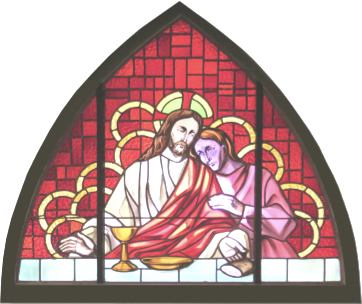
 The sacrifice by the Melchizedek, a king and priest of Salem, who worshipped the same God as Abraham, was a historical offering of bread and wine to Abraham after a battle. The window portrays the scene as described in Genesis 14: 18-20: “Then Melchizedek king of Salem brought out bread and wine. He was priest of God Most High, and he blessed Abram, saying, “Blessed be Abram by God Most High, Creator of heaven and earth. And praise be to God Most High, who delivered your enemies into your hand.”
Melchizedek is considered a forerunner to Jesus, who is described in the Roman Canon (Eucharistic Prayer I) as a priest forever “in the order of Melchizedek.” The sacrifice of Melchizedek, depicted in this window with a chalice of wine and bread. The mysterious king-priest Melchizedek’s offering of bread and wine is seen as a prefiguration of the Eucharist. The small top pane of the window with chalice and host, a sign of the Eucharist, represents this understanding.
The Eucharist is considered a sacrifice because it makes present Christ’s one, definitive sacrifice on the cross, offering it anew to God the Father as a memorial, thanksgiving, and means of grace, not a repetition.
During the liturgy of the Eucharist, Jesus offers Himself – body and blood – under the forms of bread and wine. He thereby applies the merits of His Passion for the forgiveness of sins and the sanctification of believers, transforming ordinary elements, bread and wine (top pane), into the true presence of Christ.
